
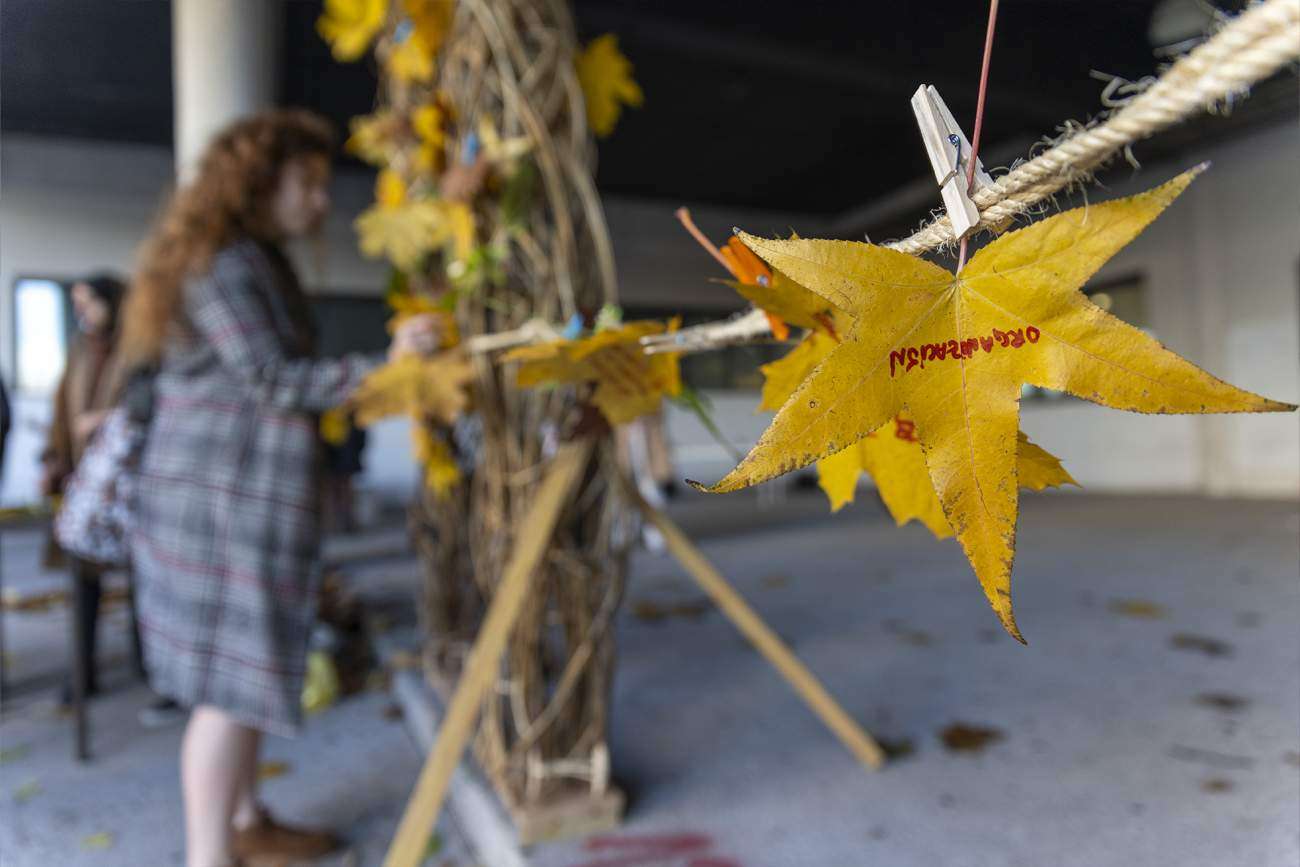
Creativity is a skill, a process and an industry. It is also a cultural, social and practical value. It stems from culture, is fostered through education, is shaped by research and finds its fullest expression in collaboration. KSIgune acts as a hub that translates creativity into collaborative processes, connecting culture, academia, industry and society.
- Article by Ruth Mayoral, Operations Director at KSIgune.
I have decided to write a few paragraphs, taking advantage of the fact that World Creativity and Innovation Day will be held on 21st April. Before embarking on this sinful task late on a Friday afternoon, I have decided to start at the beginning, which is very healthy given that we don’t do it very often with the frenetic pace of life in which we are immersed. It is not a question of going back to the beginning in time, in detail or in the sense of origin. I have not been very ambitious and have simply gone to the beginning of the statement which, on "Creativity and Innovation Day" is, no more and no less that the "Day of".
According to Google, it turns out that, as I am writing this late on Friday afternoon on 17th April 2026, it is World Haemophilia Day, International Day of Peasant Struggles and Bat Appreciation Day. Yes, I also say Bats with a capital letter, as they deserve no less. There are many events in our calendar. It is really important to give recognition to what matters - I will say that the bats seemed to me to be a bit of a joke - and it is always positive that there are these "excuse days" to highlight and even promote initiatives to support what is being celebrated.
I have the impression, however, that with these things it is a bit like the idea of Creativity itself. When we see creativity even in adding sugar to lentils, the concept is devalued and becomes nothing or, at the very least, frivolous. Not every gesture that is different represents creativity, just like not every gesture represents innovation. For creativity to take place, there has to be a meaning, beyond the self or individual. Otherwise, creative work becomes trivialised and therefore dispensable. I have some ideas regarding what I consider Creativity to be. First of all, as a great friend of mine says: "Creativity is looking at typical things in a different way".
From skill to process and added value
Breaking down the statement, creativity is a skill. It is a capacity because it involves lateral thinking, or it does not respond directly to the relatively logical, it requires imagination and an exercise in reinterpretation and sensitivity. Therefore, Culture as a symbolic substratum has a major impact and, of course, Education as a tool for socialisation has the greatest competence in fostering this capacity.
But creativity is also a process. One with different phases, starting from the idea and ending up with the result. This result must have value, be transformative (innovative), and will differ according to the type of knowledge a person masters. Think how wonderful it is that this person has the right conditions to carry out research, and even, asking for the impossible, he or she has the opportunity to conduct research in collaboration with other people who have different expertise. The results will potentially be better, more transformative and will contribute more and better.
I rewrite my previous lines replacing the word person with industry: The result will be different depending on the type of knowledge that an industry masters. Think how wonderful it is that this industry has the right conditions to carry out research, and even, asking for the impossible, it has the opportunity to conduct research in collaboration with other industries that have different expertise. The results will potentially be better, more transformative and will contribute more and better.
From an industry and public policy perspective, Creativity has been concentrated around the so-called Cultural and Creative Industries, which make Creativity an economic, social and organisational translation. Specifically in the Basque Country, these industries include a mosaic of sectors, such as Books and Press, Language Industries, Performing Arts, Audiovisual and Design, to name just a few. I have chosen to think of the categorisation of these diverse sectors as an industry, as a way of recognising that they matter and that they are valued as a trigger for innovation when creativity is applied.
Creativity is also a cultural, social and practical value. We have got used to hearing that Art is not without creativity, but neither is Science. And yet, in practice, creativity is often misunderstood as being too closely linked exclusively to Art, and this is an issue that needs to be overcome in order to deal rigorously with creative thought and the creative process. While Art is the free expression of creativity, that creativity transcends this sphere to be present in any discipline, industry or area of knowledge. From creativity, we can generate new languages and ways of expression -cultural value-, contribute to addressing joint challenges through new methodologies, points of view, ways of participating by connecting knowledge -social value-, and introducing different approaches, improving products, services, processes -practical value.
Engaging in dialogue and bridging disciplines
In the Basque Country, where innovation is at the heart of scientific and technological policy, the concept has been broadened and it is recognised that the cultural and creative industries are not merely an aesthetic complement, but they are a strategic vector. Not only do they generate economic activity, but they also bring new approaches to the social challenges we face, create new languages and connect disciplines that do not converse naturally.
In this context, ecosystems that do not create from a single sphere, but rather generate the conditions for others to create, research and collaborate take on a special meaning. Spaces that understand creativity not as an isolated result, but as a capacity that is activated when different knowledge, languages and disciplines are connected. Euskampus Fundazioa, as a strategic project in the Basque university system, represents this approach from the field of Science, advanced knowledge and research. Moreover, it has explicitly "got involved" with Culture, recognising it as an essential ally to address complex challenges from more cross-cutting and meaningful perspectives. Euskampus' boost to KSIgune, conceived as a space to articulate the potential of the cultural and creative industries within the innovation ecosystem, is part of this commitment.
KSIgune operates as a node that translates creativity into collaborative processes, connecting Culture, University, Industry and Society. It is not a question of producing from a single centre, but rather activating distributed capacities, facilitating unlikely encounters and helping others to contribute. When creativity is placed at the crossroads between Science, Culture and Industry, its transformative capacity is multiplied.
It is also worth remembering that supporting creativity also requires creativity. Facilitating processes, connecting different knowledge and sustaining complex collaborations requires specific yet often invisible work, carried out by teams that make mediation and support a daily practice. Acknowledging creativity as a common good also implies valuing those who make it possible for others to create.
Today's world requires solutions to be put forward to address very complex problems and, from this point of view, it is more important than ever to place creativity at the heart of public and educational strategies, not as an inspirational complement, but as a structural skill to think, connect and build joint responses.
Creativity is a skill, process and industry and it is also a cultural, social and practical value. It arose from Culture, is activated from Education, is articulated through Research and reaches its height when it is produced in Collaboration.
For all these reasons, it is necessary to approach creativity with rigour and to cherish it as a common good.
-----
Image: © KSIgune/Konexio-proiektuak/HASZTAPANEKAK/2024
Current issues related news
-
Culture and Science: the driving force behind Basque innovation
ksiGuneWhen talking about innovation, the conversation often revolves around technology, patents and industrial competitiveness. However, there is one piece that remains in the shadows: Culture. Not only…
-

Tailor-made innovation for the arts, culture and creativity
ksiGuneIn 2025, KSIgune promoted a boot camp, two training and research calls, and a sectoral meeting, supporting 10 new collaboration initiatives to bring innovation to businesses and make an impact on the…
-
Konexioak 2025: your chance to create and make an impact
ksiGuneIf you study, research or work contributing to the advancement of the Arts, Culture and creative disciplines such as Architecture, Fashion or Gastronomy in the Basque Country, and you want to become…